











There’s a company posting record orders, fat margins, and it just bought up five of its competitors in a single move. Business is booming. And the stock? Drifting toward its lows, flagged as a “sell,” bleeding out on the chart like it’s dying.
Kraken Robotics Annual Revenue
in millions CAD, 2022 to trailing-twelve-months 2026
Both of those things are true at the same time. That gap, between a stock nobody wants and a business that keeps winning, is the whole story. Let me walk you through it.
The numbers are actually good?
Last quarter Kraken Robotics reported revenue up 4 percent. Yawn, right? Except that headline is lying to you.
A one-time accounting quirk dragged it down. Strip that out and revenue actually grew closer to 10 percent, with product sales up 11 percent in the quarter and 25 percent for the first half of the year. The market saw “4 percent” and clicked away. It missed the real number.
And check the margins. 59 percent gross margin, ticking up year over year. That is not the profile of a company selling stuff anyone can copy. That is the fingerprint of technology customers can’t get anywhere else. Big difference.
They’re sitting on a pile of cash
This part matters more than it sounds. Small companies in growth mode usually have one enemy: running out of money before the plan pays off.
Kraken isn’t sweating it. Roughly 91 million dollars in cash, barely any debt, and it kept that cushion even after buying five companies. Translation: they can afford to be patient while the stock takes its sweet time waking up. They’re playing with house money.
The move nobody’s talking about
In July, Kraken swallowed the Covelya Group whole. Five established subsea brands, Sonardyne, EIVA, Forcys, Voyis, Chelsea Technologies, all under one roof overnight.
This wasn’t a little tuck-in deal. It widened their customer base, pushed them into new tech, and handed them a foot in the offshore energy door.
But here’s the part that actually changes the game. Kraken used to be a lumpy, unpredictable business. One big contract lands, great quarter. It slips a few weeks, ugly quarter. That made the stock a nightmare to hold. Covelya smooths that out with a wider, steadier customer base, and management is now talking about selling ongoing services, not just one-off gear. That’s recurring revenue. Wall Street pays a premium for recurring revenue.
The order book is filling up to match.
The order that tells you where this is going
Here’s a detail that got buried, and it might be the most important one. Kraken recently signed a long-term Master Supply Agreement to provide its pressure-tolerant subsea batteries to an international conglomerate building extra-large unmanned underwater vehicles, the big autonomous submarines every major navy is now racing to field. The company hasn’t named the customer, so I won’t guess at it, but this is the part of the business that quietly went from a side project to a growth engine, with close to ten new battery customers added in roughly the last eighteen months across North America, Europe, and Asia.
And when the obvious worry came up, whether these big vehicle makers might eventually just build their own batteries, the CEO pointed to Kraken’s sonar business. Customers have plenty of in-house engineering talent, and they still buy from Kraken anyway, because the pressure-tolerant tech is genuinely hard to replicate. That is what a moat sounds like when management describes it without using the word.
A potential wave of money
Zoom out. The world is pouring money into underwater defense, autonomous subs, mine-hunting tech, and inspecting the stuff sitting on the ocean floor. Kraken makes exactly that, and their pipeline is way bigger than it was a year ago.
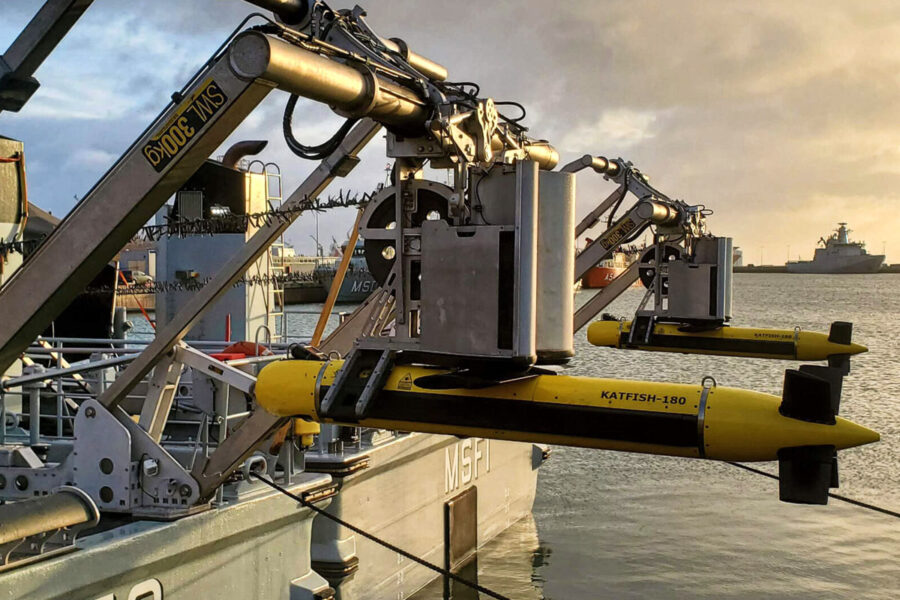
And mine-hunting is right in their wheelhouse. Their KATFISH sonar is already deployed with multiple NATO navies, Denmark, Poland, the Royal Canadian Navy, built for exactly the job modern naval doctrine now demands: find the mines without putting sailors in the minefield. Here’s why that matters. Every time a chokepoint like the Strait of Hormuz or the Red Sea flares up and naval mines creep back into the headlines, the case for autonomous mine-hunting gets a little louder. The old way, sending a crewed ship into a suspected minefield, is exactly the thing every navy is racing to stop doing. Kraken makes the thing that replaces it.
When a small, profitable company is standing directly in front of a multi-year government spending wave, you’re not betting on a quick 5 percent pop. You’re betting on what the whole thing could be worth a few years out.

Okay, so what’s the catch?
There’s always a catch, and I’m not going to pretend there isn’t.
Management said it flat out: hitting their full-year targets depends on landing one specific contract, and most of that payoff is loaded into the final quarter of the year. On top of that, blending five companies together at once is genuinely hard and takes time to get right.
That right there, the contract timing and the messy integration, is almost certainly why the stock is limping instead of ripping. That’s the risk. It’s real. And it’s exactly the risk you get paid for when you’re early.
The smart money is starting to circle
Here’s a tell worth noticing. RBC Capital Markets, the top-ranked research shop in all of Canada, just put a Buy rating on Kraken with a price target of 4.31, well above where it trades today.
Now, one analyst call isn’t gospel, and a target is a twelve-month guess, not a promise. But when the biggest research house in the company’s home country plants its flag on a tiny, overlooked stock, it drags that stock in front of big institutional buyers who never would’ve found it otherwise. That’s how forgotten names get un-forgotten.
Bottom line
Add it up. A profitable, growing, cash-rich company. Fat margins. A game-changing acquisition. A spending wave at its back. A fresh Buy from the most credible shop in its market. All of it sitting at a price the market clearly hasn’t caught up to yet.
If that final quarter delivers and the integration holds, the gap between the sad chart and the winning business closes fast, and it closes in the buyer’s favor.
The writing might already be on the wall. Most people just aren’t reading it yet.
To Recap
• Real growth ~10%, not the 4% headline (one-time reversal masked it)
• 59% gross margins = pricing power, not commodity hardware
• C$91M cash, minimal debt = staying power
• Covelya deal: 5 subsea brands, way bigger market
• Less lumpy now, broader customers
• Recurring-revenue pivot (systems + monitoring-as-a-service)
• New XL-UUV battery deal + ~10 new customers in 18 months
• C$355M orders YTD and climbing
• KATFISH mine-hunting sonar already in NATO navies
• Multi-year defense + subsea tailwind
• Fresh RBC Buy rating