



Well I just turned 35 two months ago and like half of men my age I’m experiencing hair loss. Which is something that is somewhat traumatic, it really makes you question your future for not just relationships but employment as well, it’s a great unknown while you lose something you have taken for granted your entire life.
And then you go looking for solutions, and every option to save your hair SEEMINGLY arrives arm in arm with something nasty. The pitch usually goes “hey guy, you want to keep your hair? Take this pill, just know your dick won’t work and you’ll have low motivation. Oh and rub this foam on your head that’ll bloat your face and give you palpitations. And hey, for optimal results? Do both at once! and God help you if you stop!” Getting older is already hard enough, juggling this on top of other mounting pressures men face can feel like too much.
Just Shave It?
So why not just shave it? That’s the question we should ask first. We’ve all heard it before, “just be a man, shave it, get it over with,” and the thing is, the research actually backs it up. Wharton ran three experiments on this, and men with shaved heads got rated more dominant, about an inch taller and roughly 13% stronger than the same men with hair. Visibly thinning hair scored lowest on nearly everything.
Would you look good bald though? Unfortunately life is not fair and not everyone looks good bald, some men could look like Johnny Sins or Jason Statham easily pulling off a masculine to sophisticated look, while others are not so fortunate. To help you decide, we developed a survey that you can take right here in the article.
Saving Your Hair
How does hair loss work?
You’ve seen the ads with the little cartoon DHT monsters, so here’s the short version. Your body converts testosterone into DHT, the follicles on top of your head are genetically sensitive to it while the ones on your sides and back aren’t, and every cycle a sensitive follicle makes a slightly thinner hair than the last one until eventually it stops making one at all. That’s the whole mechanism. It’s why the pattern is always the same, and why everything in this article is either blocking DHT or trying to keep follicles growing longer.
Is it even male pattern hair loss?
What the ads skip is whether that’s even your problem. If you’re thinning uniformly everywhere, including the sides and back, that isn’t pattern loss, because DHT doesn’t touch those follicles, and the usual culprit is telogen effluvium triggered by something two to four months ago like an illness, surgery, a crash diet or a new medication, which normally sorts itself out on its own. If your scalp itches, burns, stings, or is red and scaly, that isn’t pattern loss either, and a few of those conditions do permanent damage on a short clock. And smooth round patches that showed up fast are alopecia areata, which is autoimmune and responds to treatments that do nothing for a receding hairline. If any of that sounds like you, close this article and book an appointment with a dermatologist, because nothing below is the right tool.
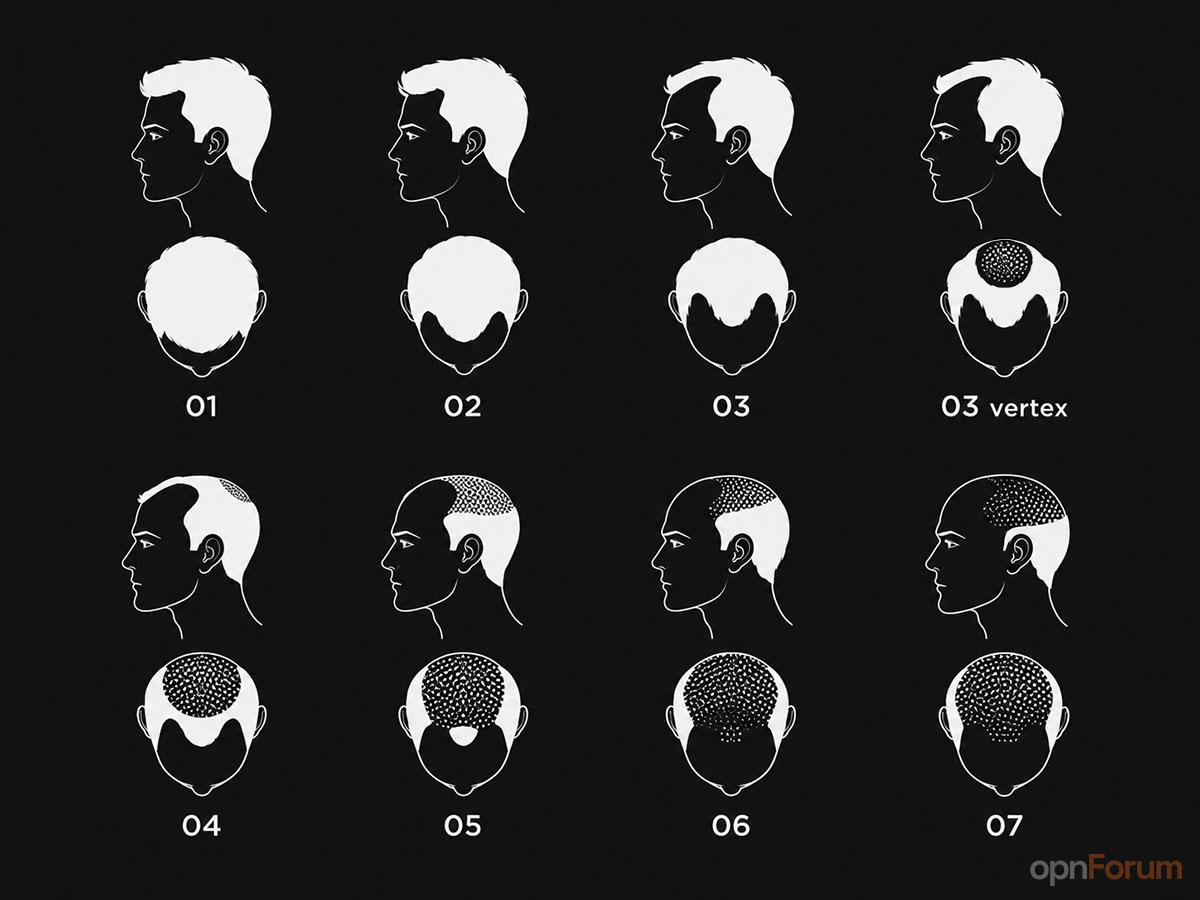
It’s possible that your hair loss has advanced past the point where modern medicine can salvage it, which means most of what follows won’t do much for you and a transplant becomes the only way to put hair back where it’s gone. Roughly speaking, if you’re somewhere in the 2 to 4 range, you’re in the window where the drugs have the most to work with. Plenty of men at 5 still respond, particularly in the crown, so don’t read the chart as a verdict. Past that though, the bare areas are generally gone and the job shifts to protecting what you still have.
Hair Loss Solutions
I’ll be straight with you, outside of S Tier, these aren’t going to reverse your hair loss or fill in a crown that’s already gone, but the research does show these methods can buy you time and hold onto what you still have. They make for strong additions, say if you’re already using minoxidil.
The list runs A down to F, strongest evidence to weakest. After that, X tier covers what’s still stuck in trials, S tier covers the proven drugs you already knew about, and H tier is the stuff that helps you without being a treatment at all.
A Tier – You should be doing this
Cheap, low risk, and every one of them has real human evidence behind it.
Ketoconazole shampoo
An antifungal dandruff shampoo, which is why nobody markets it at you as a hair product. It suppresses the scalp yeast that drives inflammation, and it appears to interfere with DHT locally at the follicle. The main study (-Piérard-Franchimont, Dermatology, 1998) ran 27 men against 12 controls for 21 months, washing two to four times a week, and found better density than an unmedicated shampoo. Worth knowing all of that was done at 2%, while the Nizoral on the shelf is 1%. And the line you’ll see everywhere, that it matches minoxidil, comes from a side arm of that same paper with four men in each group, run against minoxidil 2% rather than the 5% every man actually buys. Fifteen dollars, and the entire human evidence base here is five studies and 318 men.
Our recommendation: Nizoral Anti-Dandruff Shampoo with 1% Ketoconazole
Editor note: This is a must, and is one product even online hair loss communities can agree on. I use it as my primary shampoo and find my scalp feels incredibly refreshed after showers, I’d also reccomend paring it with a scalp massager. For 2% ketoconazole, you will need a prescription.
Microneedling
A stamp of tiny needles you press into your scalp, about once a week. The small injuries switch on your scalp’s repair machinery, which wakes up follicles, and the holes let a topical soak in instead of sitting on top of your skin. The famous number (-Dhurat, 2013) is 91.4 new hairs against 22.2 for minoxidil alone, run at 1.5mm weekly for twelve weeks. A later study (-Faghihi, 2021) found a much shallower 0.6mm still beat minoxidil alone with far less pain, which is the depth most men will actually stick with, though know that most of the research used 1.0 to 1.5mm. And doing it every two weeks seems to work at least as well as weekly, so more is not better here. Twenty dollars. The catch is that almost every study bolted it onto a drug, so using it alone means betting on the one part nobody properly measured.
Our recommendation: Follicly Derma Stamp – Professional Microneedling Tool for Hair
Disclaimer: Microneedling can cause irritation, bleeding, infection or scarring if you do it badly. Keep the stamp clean and stay off damaged or infected skin. And don’t put minoxidil on right after a session, because freshly needled skin soaks up far more of it, which means more irritation and a better chance of side effects you’ll feel in the rest of your body. That might sound like it defeats the purpose, but it doesn’t: the men in the Dhurat trial waited 24 hours before going back to minoxidil, so waiting is the actual protocol. Needle on a night you skip your topical, start again the next day.
Pumpkin seed oil, 400mg daily
Cold-pressed seed oil in a capsule you swallow, not something you rub on, and that difference matters because plenty of men put it on their scalp when the trial behind it did nothing of the kind. The theory is that it blocks the same enzyme finasteride does, though that part has only ever been shown in rats. However, in a human trial (-Cho, 2014), 76 men took either 400mg a day by mouth or a placebo for 24 weeks, and hair count climbed about 40% against 10% on placebo. Nobody has repeated it since, not once in over a decade. Take the 400mg that was actually studied, because the bottles on the shelf run 1,000mg or 3,000mg, and that isn’t a stronger version of the trial, it’s a different thing nobody tested. Fifteen dollars a month for one decent study standing alone.
Our recommendation: Pumpkin Seed Oil with Saw Palmetto
Disclaimer: This suggested product has 75mg Saw Palmetto, it’s one I personally use, but if you plan on doing a full 320mg dose of saw palmetto it’s best to pick a pumpkin seed oil supplement that doesn’t contain saw palmetto, or a 320mg saw palmetto supplement that contains pumpkin seed oil.
Saw palmetto, 320mg
An extract from the berry of the Serenoa repens palm, and the closest thing on this list to an actual drug. It goes after the same target finasteride does, blocking DHT, just more gently. The trial that matters ran the two head to head: 100 men took either 320mg of saw palmetto or 1mg of finasteride for two years, and 38% of the saw palmetto group improved against 68% of the finasteride group (-Rossi, 2012). Read that as a trade rather than a loss. You’re getting better than half the result of a prescription drug out of a fifteen dollar bottle, with no prescription, no doctor, and none of the baggage that made you hesitate in the first place. Check the label for 320mg of standardized extract per capsule, because plenty of bottles come in well under that.
Our recommendation: Doctor’s BEST Saw Palmetto Extract Supplement
Editor note: Saw Palmetto can come with side effects which CAN include stomach upset (seriously avoid taking on an empty stomach), fatigue, and decreased libido. I personally just take 75mg a day in a Pumpkin Seed Oil supplement, which is not a dosage proven to help with hair loss, but theoretically better than nothing.
B Tier – Worth Trying
Thinner evidence and bigger asterisks, but the worst case is wasted money rather than anything that costs you.
LLLT cap
A cap or helmet lined with red laser diodes, worn 15 to 25 minutes a few times a week. The theory is that red light around 650nm gets taken up by the mitochondria in your follicles and nudges resting hair back into a growth phase. This is the only thing in B tier with sham-controlled trials behind it, meaning men wore fake caps and did not know the difference, and reviews pooling those trials came out positive on hair count (-Afifi, Lasers in Surgery and Medicine, 2017). The catch is scale. Most of those trials ran under six months with a few dozen men. And these devices are FDA cleared, not FDA approved, which only means the paperwork showed it resembles something already on the market. Expect $200 to $800 for maintenance, not rescue.
Our recommendation: iRestore Professional Laser Red Light Therapy for Hair Growth System
Adenosine 0.75% lotion
A topical you work into the scalp twice a day, sold mostly out of Japan where it carries quasi-drug status. Adenosine appears to turn up FGF-7 in the dermal papilla, the signal that tells a follicle to build a thicker shaft, so the pitch is less about new hairs and more about fattening the ones you still have. A six-month trial in 102 Japanese men found more thick hair than the control arm (-Watanabe, International Journal of Cosmetic Science, 2015), and a later run in 38 Caucasian men held up. Here is the part nobody puts on the box: the comparator was niacinamide, not minoxidil, and Shiseido had people on the author list. Roughly $30 to $75 a bottle.
Editor Note: This is a hard solution to find, I found it in one product called Shiseido Adenogen, which I ordered three bottles from a Japanese site (japanwithlovestore.com). I apply it once a day after a shower.
Rosemary oil
Diluted in a carrier oil and massaged in, or bought ready-made as a leave-in. It appears to work partly as a mild DHT blocker and partly by opening up blood vessels in the scalp, which is minoxidil’s mechanism in a plant. One trial put 100 men on either rosemary oil or minoxidil for six months and the two finished about even, with less scalp itching in the rosemary group (-Panahi, SKINmed, 2015). The flaws are real. The minoxidil arm was 2%, not the 5% every man actually buys, there was no placebo group, and eleven years on nobody has replicated it. Still worth trying though, because it tied with a drug that does beat placebo in its own trials, which is more than almost anything else on that shelf can say, and at ten dollars with no systemic side effects the downside is a bottle of oil and six months of patience.
Our recommendation: Botanic Hearth Rosemary Oil for Hair Growth
DMG + Caffeine shampoo
For years the evidence behind caffeine was follicles in a dish soaked for hours, which is not what happens when you rinse your head. That changed in August 2025, with one important detail: what got tested was caffeine paired with dimethylglycine sodium salt, not caffeine on its own. A 154-man trial ran 24 weeks with a real placebo arm and proper blinding, and the DMG and caffeine formula cut hairs lost on a pull test while placebo got slightly worse (-Celleno, Journal of Cosmetic Dermatology, 2025). Read the fine print though. The pull test was the main measure, the density numbers came from a 30-man subgroup, and three of the authors work for Alpecin’s parent company. So check the label for both ingredients, because a plain caffeine shampoo is not the thing that was studied. Cheapest possible thing to bolt onto a routine, and not a reason to skip anything in A tier.
GHK-Cu (Barely Qualifies)
A copper peptide that occurs naturally in human blood and declines as you age, sold as a scalp serum. It’s a signaling molecule involved in wound healing, it has real effects on skin, and the pitch for hair is that the same repair signaling reaches the follicle. Be clear about what’s behind that though, because this is the one thing in B tier with no human trial of any kind. The evidence is cell cultures and animals, which is the same shelf green tea sits on. What earns it a spot anyway is the risk side: it’s a cosmetic grade peptide with a long safety record and no hormonal mechanism, so the realistic worst case is forty dollars and nothing happens. One caveat worth knowing is that the safety record comes from normal use on intact skin, not from daily application to a freshly microneedled scalp, where absorption is a different question.
Our recommendation: Neurogan GHK-Cu Hair & Scalp Serum
C Tier – Fixes A Deficiency
None of this grows hair, it only gives back what a shortage took, which is why the testing comes before the buying.
Disclaimer: Everything below assumes you got tested first. Treating a deficiency you only suspect is how men create new problems while the hairline keeps going.
Iron (ferritin)
Low ferritin is tied to diffuse shedding, and the thresholds get argued over, with some dermatologists wanting it above 40 and others above 70. One caution before you go buy iron though. A deficiency in a man is uncommon, and when it does show up it usually means something else is going on, often bleeding somewhere. So a low ferritin is a doctor visit, not a supplement order.
Our recommendation: THORNE Iron Bisglycinate 25 mg
Vitamin D
Follicles carry vitamin D receptors, and low levels show up repeatedly in hair loss patients. Correcting a real deficiency is sensible. Taking it while already topped off does nothing for your hair.
Our recommendation: Nutricost Vitamin D3 + K2
Zinc
A deficiency causes hair loss, supplementing without deficiency does not help, and high doses taken long term push copper down, which causes its own problems.
Our recommendation: THORNE Zinc Bisglycinate 15 mg
Editor note: Zinc is hard for the body to absorb, and the cheap form in most multivitamins barely dissolves, so get a well absorbed one like Thorne’s zinc picolinate or bisglycinate instead of just buying the biggest number on the bottle. I’ll just say on a personal note, after supplementing Zinc, my morning erections are like when I was a teen. (Context: Zinc plays a major role in testosterone production.)
Biotin
True deficiency is rare, and biotin interferes with lab assays, including thyroid and cardiac troponin tests, so a man loading biotin can hand his doctor a wrong result.
D Tier – Waste Of Money
Harmless, cheap, and backed by no human evidence whatsoever for pattern loss, which is the only nice thing I can say about it.
Green tea and EGCG
The antioxidant story sounds plausible and the lab work is real enough, but it was done on mice and in cell cultures, and a compound that keeps a follicle alive in a dish is not the same as a tea extract surviving your digestion and arriving at your scalp in a useful dose. Nobody has run it on men with pattern loss, which after twenty years of it being on shelves tells you something about who’s funding what.
Peppermint oil
Traces back to a single 2014 study in which shaved mice grew hair faster, and those mouse photos are still doing the rounds as if they came from a men’s clinic. Mouse hair cycles are not human hair cycles, mice do not have androgenetic alopecia, and the whole thing is tingly on your scalp, which people reliably mistake for something working.
Collagen
The most popular supplement in this category and the easiest to dismiss, because hair is made of keratin and not collagen, so swallowing collagen to grow hair is roughly like eating drywall to strengthen your bones. It may do something for your skin and joints. It is not doing anything for your hairline.
Castor oil
Thick, cheap, enormous on social media, and supported by exactly zero human studies on pattern hair loss. What it does do is coat the hair shaft, so strands look heavier and shinier and the whole head reads as fuller in a mirror, which is how the before and after photos get made. Your hair count has not changed.
Onion juice
Gets cited more confidently than almost anything else here, and the study behind it is real, it just wasn’t about you. It tested alopecia areata, which is an autoimmune condition where the body attacks the follicle, not pattern loss where DHT slowly shrinks it. Different disease, different mechanism, and smelling like a kitchen for six months buys you nothing.
F Tier – Just Avoid
A different problem from D tier, because this can cost you real money, real risk, or ground you can’t get back.
RU58841
Originally shared among hair loss forums as a side effect free finasteride, it’s a real pharmaceutical from the nineties, and the promise was that it would block DHT at the scalp and break down before reaching the rest of you. That promise came from one rat study in 1994. When somebody finally measured it in men, a Cologne doping lab giving six volunteers a single scalp dose, they found the drug and one of its active breakdown products sitting in the blood, and called it considerable systemic exposure (-Okutan, Biomedical Chromatography, 2026). So it does get in. What it does once it’s in there over months or years has never been published, because the only human trials that ever ran, in 2002 and 2003, posted no results and were quietly shelved.
X Tier – Experimental
Nothing here is something you can buy, which is exactly the point.None of this is approved. Some of it is available anyway, which is the difference between a treatment and a bet.
2-deoxy-D-ribose (2dDR)
The one making headlines right now. 2dDR is a sugar your own body produces, and a 2024 study found a gel of it regrew hair in mice about as well as minoxidil did (-Anjum, Frontiers in Pharmacology, 2024). Read the actual paper though and it thins out fast. Three to four mice per group, twenty days, and the minoxidil they tested against was 2% rather than the 5% any man actually buys. The two were never compared against each other statistically, and the “80 to 90% as effective as minoxidil” line everyone repeats isn’t calculated anywhere in it. There’s also no sign it touches DHT at all. A 60-person human trial is recruiting in Cairo with results due around late 2026, and in the meantime companies are already selling 5% gels, roughly twelve times what the mice got, while the researchers behind the study publicly distance themselves from them.
Clascoterone (Breezula)
The closest thing to real. A topical that blocks the androgen receptor at the follicle, already approved and sold as Winlevi for acne since 2020, so it has a safety file nothing else here can match. Two Phase 3 trials in 1,465 men reported positive results in December 2025, 12-month data held up in April 2026, and submissions to the FDA and EU are underway.
Pyrilutamide (KX-826)
Same idea, different company. Kintor’s topical androgen receptor blocker hit its primary endpoint in a 666-patient Chinese Phase 3 in March 2026, about 10.65 more hairs per square centimeter than placebo. Worth including honestly that it failed a US Phase 2 and missed an earlier Chinese Phase 3 before this one landed.
PP405
The only one doing something genuinely new. The other two are both blocking androgens. PP405 goes after follicle stem cells through an entirely different pathway, meaning it could in theory wake up follicles the DHT drugs can only protect. It’s the earliest of the three, sitting at Phase 2, and the most hyped online, which is its own warning label.
RLS-1496
Instead of going after DHT, RLS-1496 is meant to kill senescent cells, the aged and inflamed cells that collect at the base of a balding follicle and suppress everything around them. The premise has real independent support in lab work. The drug doesn’t. Every hair number attached to it traces back to a single Rubedo Life Sciences press release from September 2026, cited as “data on file,” with no sample sizes and no p-values anywhere. The headline says it matched or outperformed finasteride. The body of the same release says “numerically greater trend,” which is how you write not statistically significant. And the test added DHT straight into the dish, so finasteride, a drug that works by blocking the enzyme that makes DHT, had almost nothing left to block. The human trial the company announced for this month has no registry entry, so its size and design aren’t public. No senolytic has yet shown a clinical benefit in a controlled human trial in any disease at all.
S Tier – The Proven Methods
The stuff that actually works, which you already knew about before you opened this article.
Finasteride, 1mg daily
The benchmark. It blocks the enzyme that turns testosterone into DHT, and in the five year trials roughly nine in ten men stopped losing ground and about two in three regrew something. Nothing else on this page has anywhere near that weight of evidence behind it, which is why every other treatment here gets measured against it. The side effects are the whole reason you’re reading a tier list instead of filling a prescription. While a large number of men across the web have reported side effects, many have found them manageable by lowering their dosage while still maintaining optimal results, so how low can you go?
- 0.5mg daily, the most common step down
- 0.25mg daily, usually by quartering a 1mg pill
- 1mg every other day, or two to three times a week
As for what the research suggests about going lower than the standard dose, the smallest amount ever properly tested is 0.2mg daily, and it held up well: in one 48-week trial, 58% of men improved on 1mg against 54% on 0.2mg, with placebo at 6%, and the gap between the two doses wasn’t statistically meaningful. But be clear about what a smaller dose buys you, because it doesn’t cut the side effect risk proportionally. Even 0.2mg suppresses DHT at your scalp nearly as hard as 5mg does, so you keep most of the benefit, which is the good news, and most of the exposure, which is the asterisk. And one number from that same trial is worth sitting with before you decide anything: decreased libido was reported by 2.9% of men on 1mg, 1.5% on 0.2mg, and 2.2% on placebo. The sugar pill landed in the middle.
Potential Side Effects: In the original year-long trials of 1,553 men, 3.8% on finasteride reported a sexual side effect against 2.1% on placebo, which is a gap of under two percentage points. But the list is longer than sex, and it got longer officially: in April 2012 the FDA made Merck add libido, ejaculation and orgasm disorders that continued after men stopped taking it, along with reports of poor semen quality. Breast tenderness and enlargement show up too, and a 2021 analysis of the WHO’s global safety database found a signal for suicidality and psychological effects specifically in men under 45 taking it for hair loss, with a reporting odds ratio of 3.47, though the authors noted that could partly reflect how heavily this drug gets discussed online rather than a true excess. So the fair summary is that the clean trial numbers are low, the reports are real enough that the label changed, and nobody has reconciled the two.
Minoxidil 5%, topical
Works on about six in ten men, better on the crown than the hairline. It doesn’t touch DHT at all, it just keeps hairs in their growing phase longer, which buys time rather than fixing the cause. On how often: five percent once daily has been directly studied and shown effective in women, but in men the strongest trial evidence is twice daily, and dedicated trials of plain 5% once daily in male pattern loss are surprisingly sparse. The one head to head on frequency ran 2% once daily against twice daily, and the twice daily group grew roughly 45% more terminal hairs, though both still beat placebo (-Olsen, 1987). Worth knowing that 5% once a day likely delivers more drug than the 2% twice a day arm of that study, so the gap for men on the modern strength is probably smaller than it looks. Twenty dollars a month and no prescription, which is why it’s usually the first thing anybody tries.
Our recommendation: Men’s Rogaine 5% Minoxidil Topical Foam
Potential Side Effects: Minoxidil’s side effects are mostly local and mostly boring: itching, flaking and a dry scalp, usually caused by the propylene glycol in the liquid version, which is a good reason to buy the foam instead since it doesn’t contain any. Expect a shed in the first month or two as well, which looks alarming and is actually the drug resetting your hair cycle. The systemic stuff men worry about is real but uncommon, because minoxidil is a vasodilator and only about 1 to 2% of what you put on your head makes it into your blood. Most men feel nothing at that level, but a minority report palpitations, lightheadedness, puffiness around the face, and fluid retention you notice on the scale before you notice it in the mirror. Absorption climbs when your scalp is irritated or freshly microneedled, which is exactly why the order you do things in matters. And unwanted hair on the cheekbones or forehead is just runoff, not a mystery.
Oral minoxidil, low dose
The same drug taken as a pill at a fraction of the blood pressure dose, prescribed off-label and increasingly popular with dermatologists. Stronger than the topical for a lot of men and far easier to stick with than a foam you have to apply daily. It does need a doctor and it has real cardiovascular considerations, so this one isn’t a shortcut around the medical system.
Potential Side Effects: Everything in the topical section applies here, just more of it, because with a pill the whole dose is systemic by design rather than by accident. The signature side effect is body hair, and it isn’t subtle: in the largest safety study, roughly one in five patients grew noticeably more hair on their face, arms, hands and back (-Vañó-Galván, Journal of the American Academy of Dermatology, 2021). It’s the same mechanism that’s helping your scalp, just indiscriminate about where it shows up. Everything else landed low, with lightheadedness, fluid retention and a faster heart rate each coming in under 2%, and serious problems were rare enough that very few people stopped. It does require a prescription and a doctor willing to watch your blood pressure, which is the honest difference between this and a bottle of foam.
Dutasteride, 0.5mg
The heavyweight, and finasteride’s bigger brother. Finasteride blocks one form of the enzyme that produces DHT, dutasteride blocks both, which drops DHT in your blood by roughly 90% against finasteride’s 70%. And it won the head to head: a 917-man trial ran the two against each other over 24 weeks and dutasteride came out ahead on hair count. It’s approved for hair loss in South Korea and Japan and used off-label everywhere else, so in the US you’re going outside the label to get it. So this is the most powerful option in the article while finasteride remains the most proven, and the reason doctors still reach for the weaker one first sits in the box below.
Potential Side Effects: Same family as finasteride, and in the head to head the rates came out broadly similar, so the list isn’t what separates the two drugs. The exit is. Finasteride clears your system in hours, while dutasteride has a half life measured in weeks and still turns up in blood months after the last pill. So a bad reaction to finasteride means stopping and waiting days. A bad reaction to this means stopping and waiting out a season, with no way to speed it up. That’s the whole reason doctors start men on the weaker drug even when they expect to end up here.
H Tier – Honorable Mentions
The things that help you that aren’t treatments.
Shower Filters
Depends entirely on where you live, so look up your water hardness before you spend anything. Chlorine strips the oils out of your hair and leaves it dry and prone to snapping, and hard water leaves mineral deposits that do much the same. Neither causes pattern loss or speeds it up, because that’s DHT and genetics and it runs identically in soft water. What earns this a mention is that breakage costs you length and volume, which reads as thinning in a mirror even when your hair count hasn’t moved.
Here’s the part the category would rather you didn’t know. Chlorine is easy and most decent filters handle it. Hardness is not, and when one reviewer actually measured it before and after, none of the shower filters he tested reduced hardness at all, including three sold specifically on hard water performance. One of them, a brand claiming to reduce calcium and magnesium, came out 12.45% harder than the water going in. Removing hardness takes ion exchange resin, which almost no shower head contains, and the products that genuinely do it are $250 to $300 units you regenerate with salt. If what bothers you is mineral buildup on your hair rather than the water in general, a chelating shampoo every couple of weeks handles that for fifteen dollars.
Our recommendation: Weddell Duo Shower Filter, certified under NSF 177 and 53/42
Hair fibers
Charged keratin powder you shake onto your scalp, where it clings to the hairs you still have and makes each one read as thicker while darkening the gaps between them. It’s the only thing on this entire page that changes how you look in thirty seconds instead of six months, and it costs about twenty-five dollars. Two honest limits. It needs existing hair to grip, so it thickens thinning areas and does nothing at all for skin that’s already bare. And it’s a daily thing that can run in heavy rain or onto a collar, though a fixing spray mostly handles that, and DermMatch is the pressed-powder version if you want something more water resistant. It treats nothing and it holds nothing, but it’s honest about that, which is more than half the products in this article can say.
Our recommendation: BOLDIFY Hair Fibers for Thinning Hair, for Women & Men
Surgery / Injection
Both of these cost real money and require somebody else’s hands, which puts them in a different category from everything above. Neither one stops hair loss, and that’s the thing to understand before you book anything.
Hair transplant
The only thing in this entire article that actually puts hair back. A surgeon takes follicles from the back and sides of your head, where they’re genetically resistant to DHT, and moves them to where you’ve gone thin. They keep growing in their new spot for decades, because a follicle carries its resistance with it. That fact, incidentally, is why every theory about blood flow and clogged follicles is wrong, since transplanted hair thrives in the exact scalp that supposedly killed the hair before it.
Two things nobody selling you one wants to dwell on. Your donor area is finite, usually a few thousand grafts across your whole life, and once it’s spent there’s no getting it back, so a man who transplants at 25 may have nothing left to work with at 40. And surgery does nothing to stop the loss happening around the transplant, which is how men end up with a restored hairline and a brand new bald patch behind it. This is why reputable surgeons insist on medical therapy first and why the cheap mill clinics don’t. Expect $4,000 to $15,000 in the US, 12 to 18 months before you see the final result, and a consultation with someone who tells you to wait rather than someone who tells you yes.
PRP (platelet-rich plasma)
A clinic draws your blood, spins it to concentrate the platelets, and injects that back into your scalp, the idea being that the growth factors wake up struggling follicles. The pooled numbers are decent: one meta-analysis took density from 141.9 to 177.5 hairs per square centimeter, and another found a gain of about 27 hairs per square centimeter over controls. But every review reporting those numbers also flags high variability between studies, low study quality and likely publication bias. And there’s still no agreed protocol on spin speed, session count or spacing, which means two clinics charging you the same money are not selling you the same treatment. Budget $500 to $1,500 for a course, plan on maintenance sessions, and know that the gains fade once you stop. It’s a real effect sitting on shaky evidence, which is an uncomfortable place for something this expensive.
My Routine
Just because I wrote this article don’t think I have a winning routine guaranteed to stop hair loss without side effects. What I have is a routine tuned to avoid them. My biggest fear is loss of motivation, decreased libido and erectile dysfunction, which can show up with the leading DHT blockers. Not always, but they can. The logic is mostly fear talking: why have great hair if my sex life takes a hit, or if I just feel miserable? I know that isn’t everyone’s experience and the only way to find out is to try it yourself. But I also don’t think I’m at the stage where I need finasteride, since my loss is still mild enough that most people can’t tell unless I point it out to them.
So right now I use 5% topical minoxidil foam once a day, mostly on the crown, take pumpkin seed oil with 75mg of saw palmetto, wash with Nizoral three or four times a week, and apply Shiseido Adenogen (Adenosine) after I shower. The strategy is to hold what I have for about three to five years primarily relying on minoxidil. After that, depending where I am in life, I either shave it, add finasteride, or best case scenario a new drug arrives that truly stops DHT at the follicle without going systemic.
Concluding
Concluding on my longest article yet, and whatever path you pick, whether that’s shaving it, saving it, or restoring it with surgery, I want to end on a personal note. What matters more than your hair is YOU. Nobody is putting anywhere near as much thought into your appearance as you are. Good hair can earn you bonus points, sure, but what people actually remember is your character, your charisma, your confidence, your drive, your work ethic, and how you take care of yourself. Nobody can take any of that from you. And plenty of men with a full head of hair come up short on all of it.
———-
Disclaimer: Some of the links in this article are affiliate links, which means I earn a commission that goes to supporting the site if you buy through them, at no extra cost to you. That said, I have only linked to products I use myself or had a high interest in and the data backs up. I have tried my very best to represent each potential solution as honestly and critically as possible, which is also why there are entire tiers on this page telling you not to buy things.